
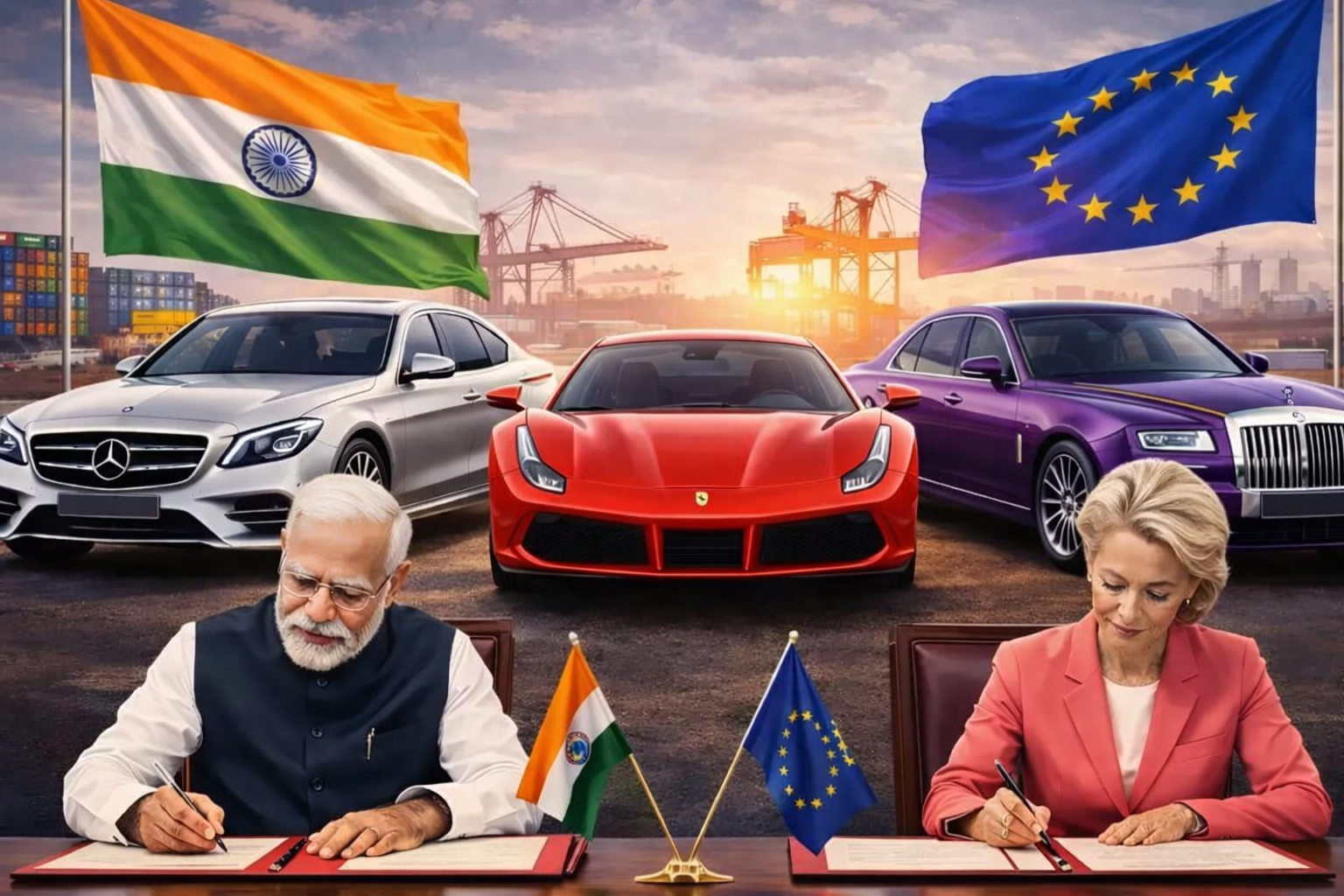
Indian car buyers may soon find European luxury cars significantly more affordable, thanks to the India-European Union Free Trade Agreement (FTA). Under the agreement, import duties on European cars are set to see a substantial reduction, bringing down tariffs from as high as 110% to as low as 10% over a gradual timeline.
Every year, Indians purchase more than 4.1 million cars, with around 45,000 units coming from European manufacturers. Following the FTA, import duties on these vehicles will be drastically lowered, offering potential savings on brands such as Mercedes-Benz, BMW, Audi, Ferrari, Lamborghini, and Porsche.

Luxury Car Prices Expected to Drop
Mercedes-Benz, a leading luxury car brand in India, offers 35 models ranging from the A-Class Limousine, priced at ₹44.46 lakh, to the ultra-luxurious Maybach SL 680, priced at ₹4.35 crore. Post-FTA, the Maybach SL 680 could see its price drop to around ₹2.28 crore, while the AMG G-Class and AMG GT could be available at ₹1.52 crore and ₹1.6 crore, respectively.
BMW, which sells over 18,000 units in India annually, is also set to become more affordable. Popular models such as the BMW 3 Series LWB, priced at ₹60.45 lakh, may drop to ₹31 lakh, and the X1, currently ₹50.6 lakh, could cost just over ₹33 lakh. Similarly, the BMW 2 Series Grand Coupe may fall from ₹45.3 lakh to approximately ₹31 lakh.

Ultra-luxury brands like Ferrari will also see steep reductions. The Ferrari Purosang SUV, priced at ₹9.93 crore, could become available for ₹5.19 crore. Other models, such as the Ferrari 296 GTB and Ferrari Roma, are expected to drop to ₹3.41 crore and ₹2.37 crore, respectively. Porsche, which sold 10,613 vehicles in India in 2024, could reduce prices for models like the 911 from ₹2.31–4.39 crore to around ₹2.67 crore.
Mass-Premium Cars: Smaller Impact
More affordable European brands, including Volkswagen, Škoda, and Renault, are likely to see minimal price changes. Many of their entry- and mid-level models are assembled locally, meaning they already avoid import duties. However, fully imported models like Volkswagen’s Golf GTI and Tiguan R-Line could drop from ₹50.91 lakh and ₹45.73 lakh to ₹26–26.23 lakh. Škoda’s Octavia VRS and Superb variants may also see price cuts from ₹50–54 lakh.

Despite the reductions, these brands sell far fewer vehicles in India than in Europe. For example, Škoda sells 44,866 units annually in India compared to 836,000 in Europe, while Volkswagen sells around 42,230 units locally versus over a million in Europe.
Impact on EVs and Pre-Owned Cars
Electric vehicles (EVs) are largely excluded from the initial tariff cuts to protect domestic EV manufacturing. This means luxury and conventional European cars will benefit immediately, while imported EVs will remain relatively expensive for now.

The second-hand luxury car market in India, which sold around 80,000 units in 2024—surpassing new luxury car sales of 50,000 units—may also feel the effects. Lower prices on new luxury cars could shift buyer preference, affecting the resale market for pre-owned high-end vehicles.
The India-EU FTA is expected to make European luxury cars more accessible to Indian buyers, potentially transforming the automotive landscape for high-end vehicles in the country.

Leave a Reply